Jessica's Instruments
During her time at Eastman, Jessica had cycled through many instruments as part of her public school instrumental music curriculum (violin, French horn, etc).
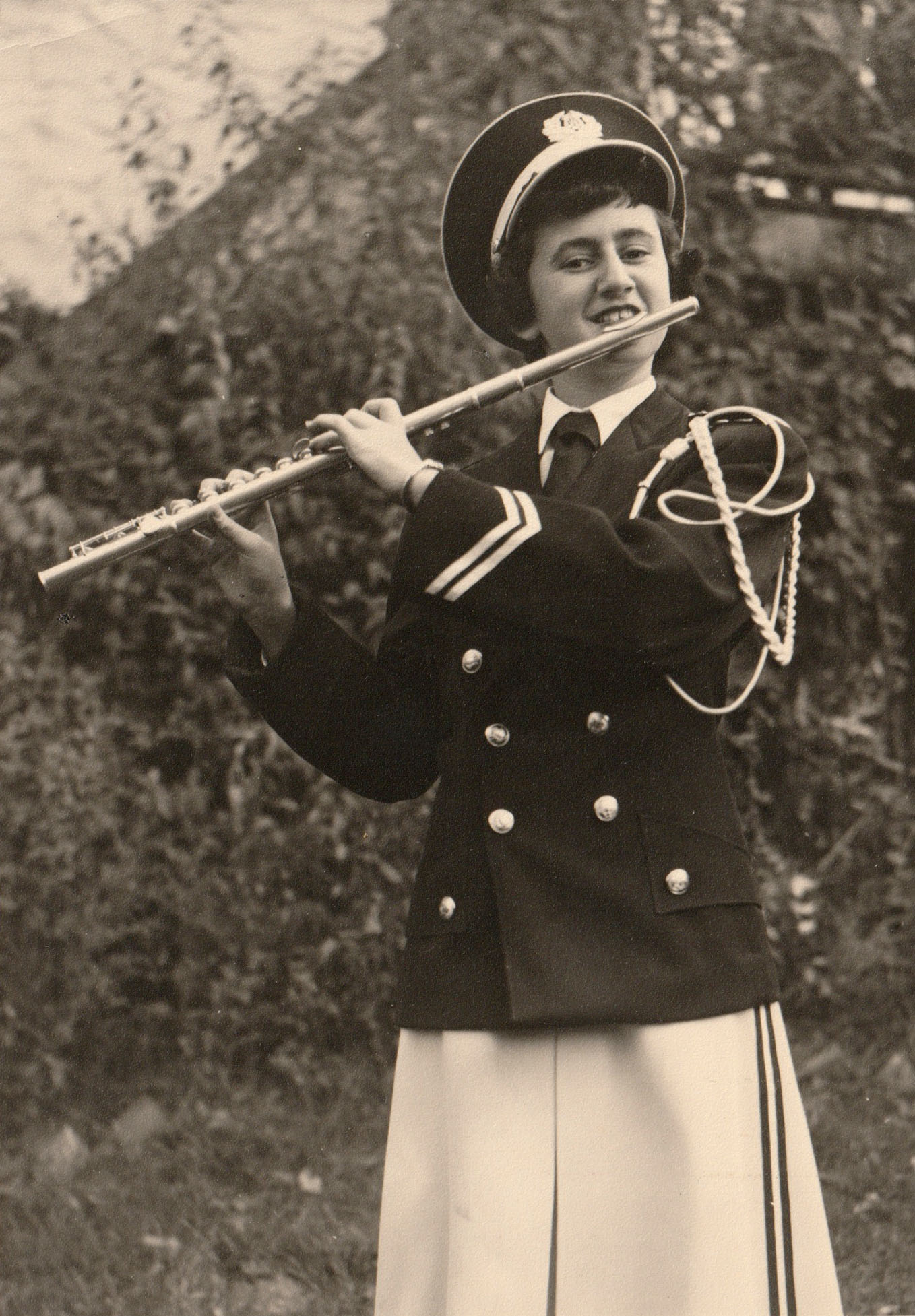
In high school, she had played flute (orchestra (first-chair), band (first-chair), All State Sectional Band (first chair in 200 piece ensemble), plus marching band).
However, keyboards were her enduring instrumental love.
Piano

June 1972: Rachel playing piano
I am not sure what piano she had at home at first. but by 1969 she had acquired a Yamaha P1 upright made in 1964. From what I have read, this was unusual, because this was not an instrument commonly imported into the United States. This resided in our living room for five years or so, before being moved to the dining room to make way for the harpsichord.

Harpsichord

testimonials ad
PDF: 2 pages, 4MB
In the 1970s, she fulfilled a dream of having her own harpsichord. Jessica and Michael
purchased a Zuckermann kit of a Flemish design.
She had first seen descriptions of the kits in the mid-1960s:
Zuckermann was one of the pioneers in making do-it-yourself kits that could result in quality
instruments (harpsichords, clavichords, etc).
[Background: a harpsichord is a predecessor to the piano, historically. It has a wooden frame and the strings are plucked for its distinctive sound. By contrast, a modern piano has a metal frame (can withstand much higher tension of the strings), and the strings are struck with felt-covered hammers.)]

Construction manual
PDF: 81 pages, 33MB
Construction
She and Michael decided that given the complexity of building an instrument (see 81 page construction manual linked above!) that they would have someone else build it for them. This was possible because of their knowing people in the Baroque authentic music performance program through the Washington University Music Department.
Specifically, they hired Craig Lister, PhD to do the construction for them, as he had studied instrument-building in Boston (where Zuckermann Harpsichords International and some other kit-producing companies (such as Frank Hubbard's eponymous Hubbard Harpsichords (web site last updated in 2006!)) resided.
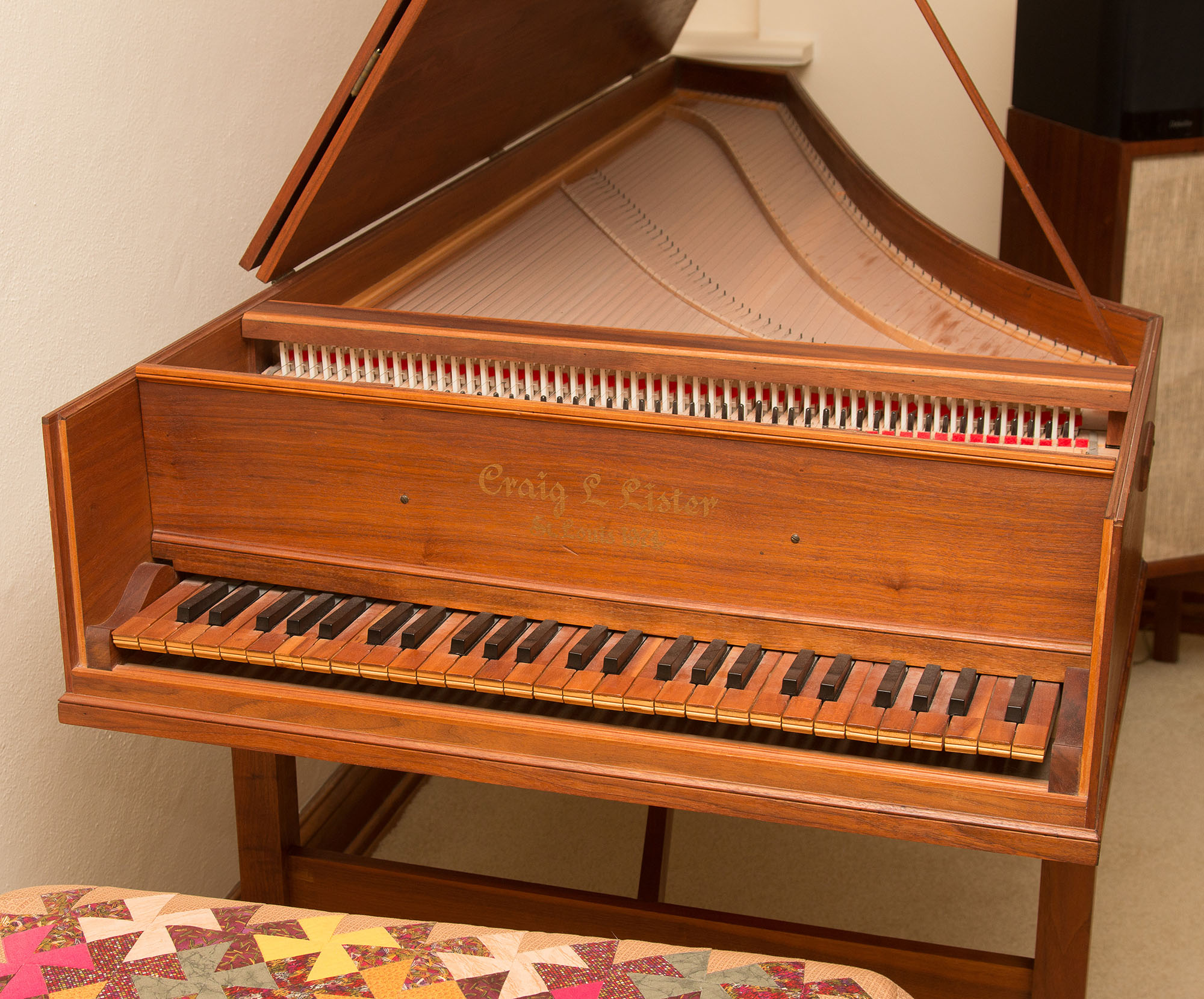
Thus, during the 1973-74 academic year, Craig came to Jessica and Michael's home and built their harpsichord in the basement. I( David) remember very clearly coming home after school (4th grade) and frequently going down to the basement to see Craig working and the instrument coming together. (Again, the manual makes clear how painstaking a process this was!)
It was a beautiful instrument: walnut and walnut veneer throughout, with cherrywood keys and black accidentals (the keys that are white ivory and ebony, respectively, on pianos). The whole instrument sat on a trestle that was removable for transport.
The harpsichord had two sets of strings (called "four foot" and "eight foot" because their range matched organ pipes of those rough sizes). One could play one register or the other or both at once (that is, pressing a key plucked two strings an octave apart). It also had a "lute stop," which was set of felt dampers which changed the timbre of the one set of strings (the four foot?) for a darker sound. (This is completely independent of the felt pieces that stopped the sound completely when one released a key.)
By April 1974 or so, the instrument was done. Jessica then hired someone else to "voice" the instrument. What this meant was that the "plectra" (the small (1x5mm?) pieces of nylon which plucked a string when a given key was hit) needed to be shaved down to make a better sound, which is what helped turn it from a thudding sound to a musical instrument.
When the harpsichord was moved to the living room (from the basement!), the Yamaha piano moved to the dining room.
Craig went on to build harpsichords throughout the rest of his career at various places around the country. In fact, a web page for the University of Texas-Permian Basin Music Department (retrieved in December 2025) mentions "instrumentalist Craig Lister who is a renowned harpsichord builder."
Rehearsals and Performances
By this time, Jessica had already been performing for several years with the Washington University Camerata (authentic performance practice of Baroque music). With the harpsichord, rehearsals transitioned to their Alta Dena home (since the other instruments are far more portable!). Thus, Rachel and David grew up with live chamber music in our living room with exotic instruments like viola da gamba, baroque violin, wooden baroque flutes, sackbuts, and more.
For concerts, the harpsichord was lifted off its trestle, wrapped securely in blankets, and put in a VW Bus owned by one of the members of the group. The group regularly performed at Wash U (Holmes lounge and other places) as well as around the city.
As David grew older (and more capable on violin), he and Jessica also played together, on repertoire such as Bach sonatas (violin and harpsichord) and Mozart sonatas (violin and piano).
Steinway Piano

1893 Steinway upright
In the fall of 1998, Jessica acquired a piano from a longtime-family friend. Edith Silver (1905-2001) was a violinist and a very close family friend of decades standing (along with her husband, Professor Isadore Silver). In the
living room of their University City home was a beautiful 1893 Steinway upright.
In the fall of 1998 as Iz's health was declining, Edith made the decision to move from their house to an apartment. In the process of downsizing, Edith offered the Steinway to Jessica.
In turn, Jessica and Michael offered their Yamaha to David and Sheryl, and thus the Yamaha was delivered to their home in Maryland on the day of an ice storm in early January 1999.
The Steinway was a remarkable instrument. Its soundboard was the size of a baby grand, but situated vertically, making it far taller than nearly any other upright piano. On the metal frame it was marked "By Appointment to her Majesty the Queen," but this meant Queen Victoria, not Queen Elizabeth, since it was made in 1893!
Dénouement for keyboards
In the fall of 2022, as Jessica was preparing to move out of the Alta Dena house, she decided that she would be unable to take either the harpsichord nor the piano to her new apartment at The Gatesworth independent senior living community. She sought the help of Dolores Pesce, a longtime friend and professor in the Wash U Music Department.Jessica wanted to ensure that the instruments would be played (not sit around as furniture) and yet she did not want them abused, either by young children with sticky fingers or by residing in a practice room somewhere where college students would sit on them or put drinks on the lids, ruining the surface.
Through contacts of Dolores, great new homes were found:
- The harpsichord went to Jeffrey Noonan, founder and director of Early Music Missouri (EMMo), where it has been actively used in rehearsals and touring performances. (It is more portable than a "double manual" (two-keyboard) instrument.)
- The Steinway went to a member of the Wash U Music Department (Director of Guitar) for their office/studio at the 560 Music Center building (the 1930 Shaare Emeth Temple building).
After Jessica's passing, Jeffrey Noonan and EMMo made a special mention (to their email list and on their web site), noting her support of the group and the donation of her harpsichord.
Autoharp

Oct. 2000: Jessica with grandson Noah (20 months)

Jan. 2005: Jessica with grandsons Noah & Rafael
Note harpsichord and piano in background
While Jessica did play piano regularly for her nursery schools, she often used an autoharp too, due to its obvious portability.
In her retirement, the autoharp remained useful, for playing with her grandsons and for doing music lessons at the Zelda Epstein Day Care Center.
(The autoharp (Wikipedia), in case one is not familiar with it, is a member of the zither family, where there are keys to press to enable chords in different keys when strumming.)
Dec. 2006: Take Me Out to the Ballgame (clip)
One last autoharp item: Jessica singing the end of
"Take Me Out to the Ballgame" with grandsons Noah (age 8) and
Rafael (age 4), where Rafael loudly (but on pitch)
asks for help to take off his sweatshirt.
This 15-second clip is an early digital movie,
made on a Canon Powershot G3 at its video resolution
of 320x240 (1/4 that of standard resolution, 640x480).
Clip by David, 27 December 2006.
Yet other instruments
There were also other instruments around the house at one time or another. One I recall was a "portatif organ" (Wikipedia, sometimes spelled "portative). this was a keyboard instrument with a very small keyboard (2 octaves?). While normally these instruments had manually operated bellows to provide the air flow for the organ, this one (in a nod to modernity, I suppose) had a hefty box (with an electric motor as I recall), about a 20 inch black wood cube, which sat in the corner of the dining room when not in use. I remember it being referred to as the D.O.B (the "damn organ box") , partially because of the space it consumed.